Anchor text optimization sits at the heart of every effective link-building strategy. When you're running an SEO audit or refining your link profile, one question surfaces repeatedly: Should you target exact match or partial match anchor text?
The answer isn't binary. Both approaches carry distinct advantages and risks, and the ratio between them can determine whether your backlink profile looks natural or triggers algorithmic penalties. For SEO specialists and link builders, understanding the mechanics behind each type is non-negotiable.
Getting this wrong means wasted outreach, lost rankings, or worse, a manual action from Google. This comparison breaks down both approaches across practical dimensions so you can build an anchor text strategy grounded in data, not guesswork.
Key Takeaways
- Exact match anchors are powerful but risky when overused in your link profile.
- Partial match anchors provide contextual relevance while appearing more natural to search engines.
- Google's Penguin algorithm specifically targets manipulative exact-match anchor text patterns.
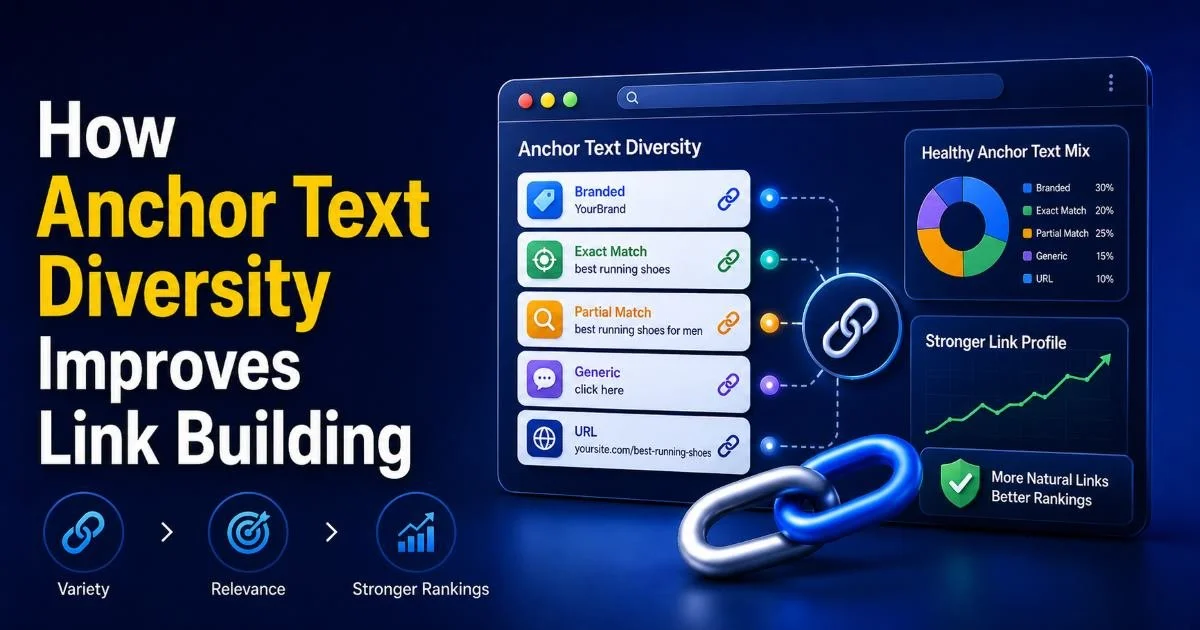
- A healthy backlink profile blends multiple anchor types with no single type dominating.
- Regular audits help you spot anchor text imbalances before they cause ranking drops.
Definitions and Core Differences
What Is Exact Match Anchor Text?
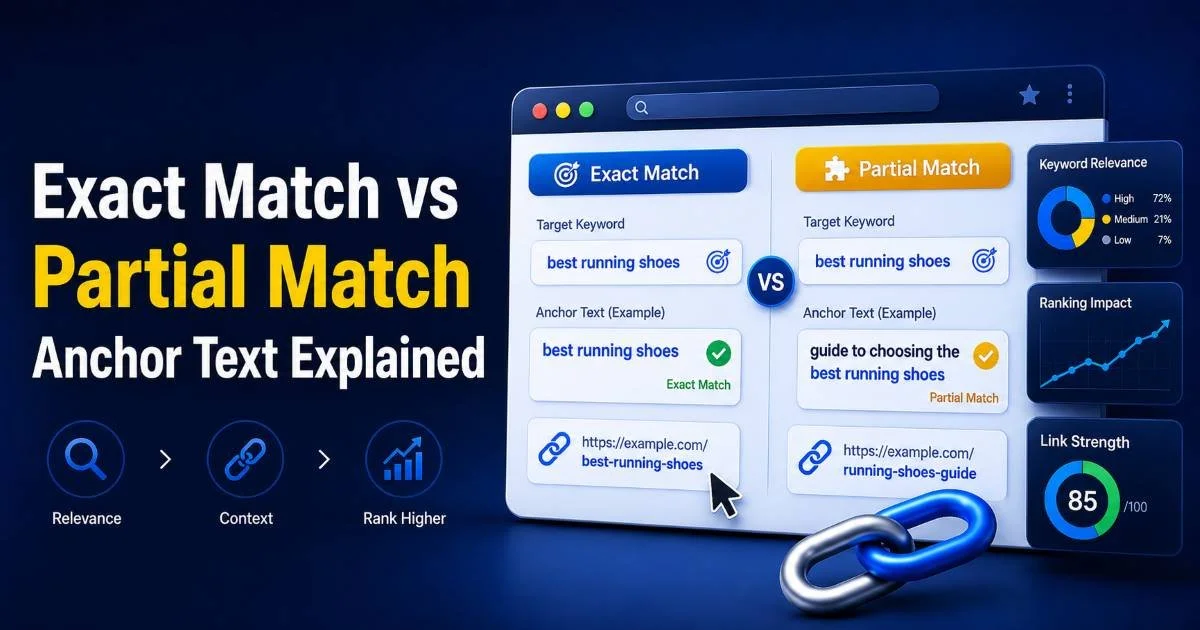
Exact match anchor text uses the precise keyword or phrase you want to rank for as the clickable link text. If your target keyword is "best running shoes," the anchor text would read exactly "best running shoes," nothing added, nothing altered. This type sends the strongest topical signal to search engines about the linked page's content. It's the most direct way to tell Google what a page is about through its inbound links.
The strength of exact match anchors comes from their specificity. Search engines have historically weighted anchor text heavily in their ranking algorithms. A study by Ahrefs found that pages ranking in the top positions often had some exact match anchors in their backlink profiles. However, the operative word is "some," not "most." Understanding what constitutes quality anchor text means recognizing that precision without moderation becomes a liability.
What Is Partial Match Anchor Text?
Partial match anchor text includes your target keyword alongside other words, creating a more natural-sounding phrase. For the same "best running shoes" example, a partial match might read "guide to the best running shoes for beginners" or "finding running shoes that last." The target keyword appears within the anchor, but it's surrounded by additional context. This mirrors how people naturally link to content; they describe what they're linking to rather than inserting a raw keyword.
Partial match anchors offer flexibility. They let you target long-tail variations, incorporate brand mentions, and build topical associations without repeating the same phrase across dozens of backlinks. For link builders managing campaigns at scale, partial match anchors provide room to diversify without sacrificing relevance. They also tend to look more editorial, which matters when you're earning links from high-authority publications that would never publish an obvious keyword-stuffed link.
SEO Impact and Risk Comparison
Ranking Power
On a per-link basis, exact match anchors carry more concentrated ranking power for a specific keyword. A single backlink with exact match anchor text from a high-authority domain can move the needle on rankings faster than a partial match equivalent. This is why exact match anchors remain popular in competitive niches where every ranking signal counts. The direct correlation between anchor text and target keyword makes these links highly efficient when used sparingly.
Read also What Is SSL Certificate Checker? A Complete Guide
Partial match anchors distribute their signal across a broader set of related terms. While one partial match link won't pack the same punch for a single keyword, multiple partial match anchors collectively build strong topical authority. They help pages rank for semantic variations and long-tail queries that exact match anchors miss entirely. For modern SEO — where Google understands intent and context far better than it did a decade ago — this broader approach often outperforms a narrow exact match strategy over time.
"The best link profiles don't rely on any single anchor type — they reflect how real humans actually reference content across the web."
Penalty Risk
Google's Penguin algorithm, first launched in 2012 and integrated into the core algorithm in 2016, was designed specifically to combat manipulative link practices. Exact match anchor text overuse sits near the top of its detection signals. If 30% or more of your backlinks use the same exact match anchor, you're painting a target on your domain. The algorithm identifies unnatural patterns, and nothing looks more unnatural than dozens of unrelated sites all linking to you with identical keyword-rich text.
Partial match anchors carry substantially less risk. Because they vary in wording even when targeting the same topic, they create the kind of diverse anchor text distribution that organic link profiles naturally exhibit. That said, they aren't immune to penalties. If you're building partial match anchors that all contain the same core phrase with only minor word variations, Google's pattern recognition can still flag the behavior. The six types of anchor text all play a role in building a profile that withstands algorithmic scrutiny.
An exact match anchor ratio above 10-15% of total backlinks is a red flag that often precedes ranking drops.
When to Use Each Type in Your Anchor Text Strategy
Exact Match Use Cases
Exact match anchors work best when used strategically and infrequently. Reserve them for your highest-authority backlinks, think links from industry publications, major news sites, or established resource pages. A single exact match anchor from a domain with a DR of 70+ can deliver more value than ten partial match anchors from weaker sites. Use them when you're confident the placement looks editorial, and the surrounding content provides genuine context for the link.
They're also effective for internal linking, where you control the context entirely. Internal exact match anchors carry less penalty risk because search engines understand that site owners naturally use descriptive anchors within their own content. When you're linking between blog posts or from a resource hub to a target page, exact match text is appropriate and expected. Just avoid making every internal link an exact match — variety matters here too.
Limit exact match anchors to 3-8% of your total backlink profile for competitive commercial keywords.
Partial Match Use Cases
Partial match anchors should form the backbone of most link-building campaigns. They're your workhorse — versatile enough to use across guest posts, digital PR placements, broken link building, and niche edits. When you're conducting outreach at scale and placing links across many different domains, partial match anchors give you room to vary your text while maintaining keyword relevance. They also sound more natural in pitches to editors and webmasters, increasing your placement success rate.
Use partial match anchors when targeting pages that need to rank for multiple related keywords. A product category page for "hiking boots," for example, benefits from anchors like "waterproof hiking boots for trail use," "affordable hiking boots reviewed," and "how to choose hiking boots." Each link reinforces the page's topical relevance without repetition. This approach aligns with how Google's natural language processing evaluates link context — it's looking at the full picture, not just the anchor text in isolation.
Partial match anchors are most effective when the surrounding paragraph content also relates to the linked page's topic.
Building a Balanced Link Profile
Ideal Anchor Text Distribution
No single distribution formula works for every niche, but analysis of top-ranking pages reveals consistent patterns. Branded anchors typically make up the largest share, followed by naked URLs, generic anchors ("click here," "this article"), partial match, and finally exact match. The exact percentages vary by industry competitiveness, but the hierarchy tends to hold. Sites in highly competitive niches like finance or legal tend to need even more conservative exact match ratios than those in less contested spaces.
The table below compares how anchor text composition shifts depending on niche competitiveness. Notice how exact match usage drops as competition increases because Google applies more scrutiny to backlink patterns in high-value keyword spaces. Adjusting your distribution based on your competitive landscape is a fundamental part of effective link profile management.
Auditing Your Current Profile
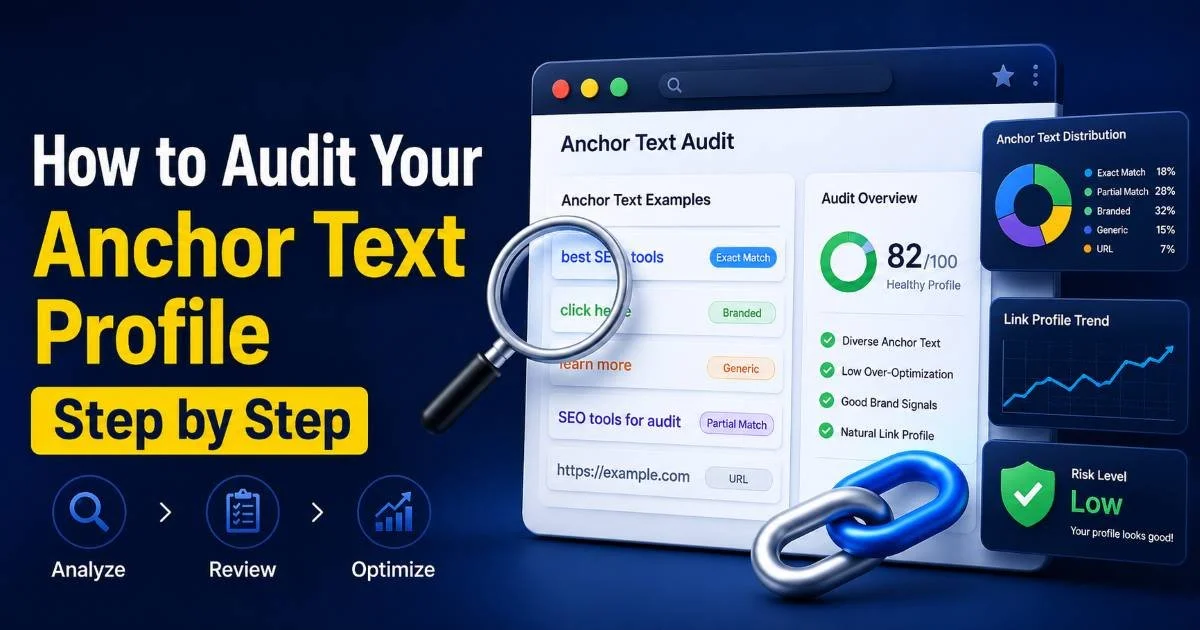
Regular anchor text audits reveal problems before they escalate. Export your backlink data from your preferred tool Ahrefs, Semrush, or Majestic, all of which work, and categorize each link by anchor type. Look for concentration spikes: is any single exact match phrase used more than 5% of the time? Are your partial match anchors truly varied, or are they minor rewrites of the same phrase? These patterns tell you where to focus your next round of link building to rebalance the profile.
Tools like Anchor Tool can accelerate this process by analyzing anchor text quality, variety, and relevance across your entire link profile. What you're looking for is a distribution that mimics natural linking behavior, the kind of profile a site would develop organically over years of earning links through quality content. When you spot imbalances, adjust your outreach strategy accordingly, targeting the anchor types that are underrepresented in your current profile.
Run an anchor text audit quarterly, or after every major link building campaign, to catch distribution shifts early.
Frequently Asked Questions
?How do I fix an exact match anchor text ratio that's too high?
?Does partial match anchor text rank as well as exact match?
?How long does it take to rebalance a manipulative link profile?
?Is it a myth that Google ignores anchor text signals now?
Final Thoughts
Exact match and partial match anchor text aren't opponents; they're teammates that serve different roles. Exact match delivers precision when used sparingly and from strong domains. Partial match provides the diversity and topical breadth that modern search algorithms reward.
The most effective SEO specialists treat anchor text optimization as portfolio management: spread the risk, vary the assets, and monitor the balance regularly. Build your link profile with intention, audit it with discipline, and let the data, not assumptions, guide your ratios.
Disclaimer: Portions of this content may have been generated using AI tools to enhance clarity and brevity. While reviewed by a human, independent verification is encouraged.